
Treatment
About the treatment
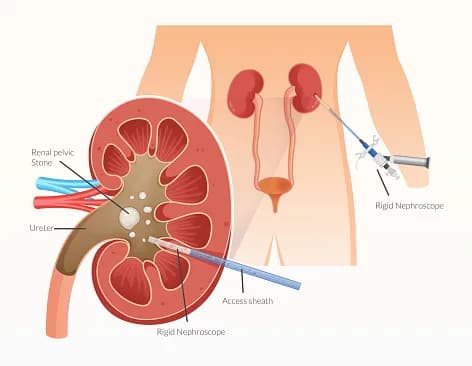
Kidney stone surgery covers the procedures used to break up and remove kidney stones that cannot pass on their own, cause severe pain or infections, or block the flow of urine. Today, options such as ureteroscopy with laser lithotripsy make it possible to treat many stones without incisions, working through the body's natural urinary passages. At Healthcare by the Sea, an outpatient medical center in Puerto Vallarta, board-certified specialists guide you closely through every step, and in most cases patients go home the same day. Schedule a personal consultation to learn which option may be right for your case.
- Area
- Urology
- Body area
- Kidney and ureter
- Setting
- Outpatient
- Type
- Surgical
Who is a candidate?
You may be a candidate for this surgery if you have a stone that is too large to pass on its own, causes pain that medication cannot control, leads to repeated urinary tract infections, or blocks the flow of urine and puts kidney function at risk. It may also be considered when a stone has not moved after a reasonable period of watchful waiting with fluids and medication.
During your consultation, Dr. Bricio, urologist (Endolapv), performs a personalized evaluation: he reviews your symptoms, your imaging studies, and your medical history — including previous infections, prior surgeries, and the medications you take — to determine whether the procedure is right for you and which technique makes sense given the size, location, and characteristics of your stone.
How it is performed
The procedure is performed under anesthesia — general anesthesia or sedation, depending on the planned technique, your overall health, and your urologist's recommendation — so you feel no discomfort while it takes place.
In ureteroscopy, one of the usual techniques for many stones in the ureter and kidney, the urologist passes a thin tube with a camera (ureteroscope) through the urethra and bladder, with no incisions needed. Once the stone is located, it can be removed with a small basket or broken into fragments with laser energy, so the pieces can be retrieved or later pass with the urine. Sometimes a thin, flexible tube (a double-J stent) is left in place temporarily to keep urine flowing while the ureter heals. The specific technique is decided at your evaluation, based on your individual case.
Afterward, you rest in a recovery room under close observation by the medical team. As an outpatient procedure, most patients return home the same day, with clear instructions and the attentive support of our team.
Preparation
Everything starts with a consultation: your specialist reviews your medical history and orders imaging studies — such as a CT scan or ultrasound — to determine the size and location of the stone, along with urine and blood tests to rule out an active infection before the procedure.
Tell your doctor about all the medications and supplements you take. You may be asked to stop those that increase bleeding — such as blood thinners, aspirin, or ibuprofen — with the timing your doctor specifies, and only if your doctor instructs you to, and to fast beforehand if anesthesia will be used. If you smoke, stopping is recommended, since smoking slows recovery.
Arrange for someone to drive you home after the procedure and stay with you for the first few hours. Our team in Puerto Vallarta can help you coordinate these details — especially if you are traveling from another city or from the U.S. or Canada.
Recovery
After ureteroscopy, it is normal to feel burning when you urinate, notice slightly pink urine, and need to urinate more often for the first few days. Drinking plenty of water helps flush the urinary tract, and your doctor may prescribe pain relievers or medication for bladder discomfort. Many patients return to light activities within a few days, following their specialist's guidance.
If a double-J stent was placed, you may feel some pressure or urinary urgency while it is in; it is removed in the office when your doctor advises. In addition, analyzing the stone fragments can guide changes in hydration, diet, or medication to lower the chance of new stones forming, with close follow-up from your urologist.
Go to the emergency room right away if you develop a high fever or chills, heavy bleeding in the urine or blood clots, pain that gets worse instead of better, or you are unable to urinate, and notify the doctor who performed your procedure as soon as possible.
Medical reference source: Mayo Clinic.
Related procedures
Urology
Cystoscopy
Cystoscopy is a diagnostic procedure that lets the urologist examine the inside of the urethra and bladder using a thin tube with a camera and light, called a cystoscope. It helps investigate concerns such as blood in the urine, frequent urinary tract infections, or persistent urinary symptoms, and when needed, small tissue samples can be taken or minor treatments performed during the same visit. At Healthcare by the Sea, an outpatient medical center in Puerto Vallarta, board-certified specialists guide you closely through every step, and in most cases patients go home the same day. Schedule a personal consultation to find out whether this exam is right for you.
View details Most requested
Urology
Rezum therapy
Rezum therapy is a minimally invasive treatment that uses water vapor (steam) to shrink excess prostate tissue and relieve the urinary symptoms of benign prostatic hyperplasia (BPH). It is an outpatient procedure: most patients go home the same day, with no incisions and a lower likelihood of sexual side effects than many other prostate surgeries. At Healthcare by the Sea, an outpatient medical center in Puerto Vallarta, Dr. Bricio, urologist (Endolapv), can evaluate your case and help you decide whether Rezum is right for you. We invite you to schedule a personalized consultation with our team.
View details
Urology
Varicocelectomy
A varicocelectomy is surgery to repair a varicocele — enlarged veins inside the scrotum, similar to varicose veins in the legs. The procedure seals off the affected veins so that blood flow is redirected into healthy ones, and it may be recommended when a varicocele causes pain, affects the size or development of the testicle, or is linked to fertility problems. It is an outpatient procedure: in most cases you go home the same day. At Healthcare by the Sea, an outpatient medical center in Puerto Vallarta, board-certified specialists guide you closely through every step. Schedule a personal consultation to find out whether this surgery is right for your case.
View details